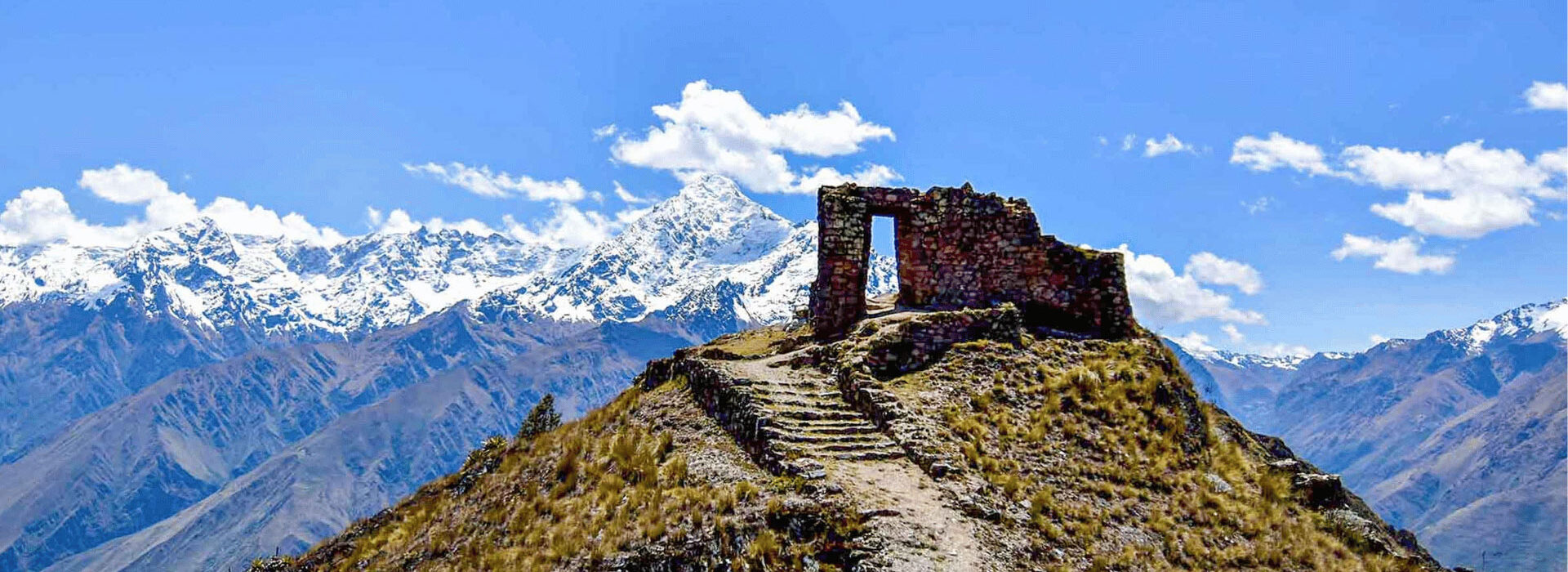
For a long time, there were enormous enigmas about how the Incas cut and transported enormous carved stones for their builts. This is how the Cachicata quarry, one of the most representative destinations near Ollantaytambo town, solves some of these mysteries. Discover below, in this blog, everything you need to know about the hike to Cachicata Quarry or Intipunku with Inkayni Peru Tours!
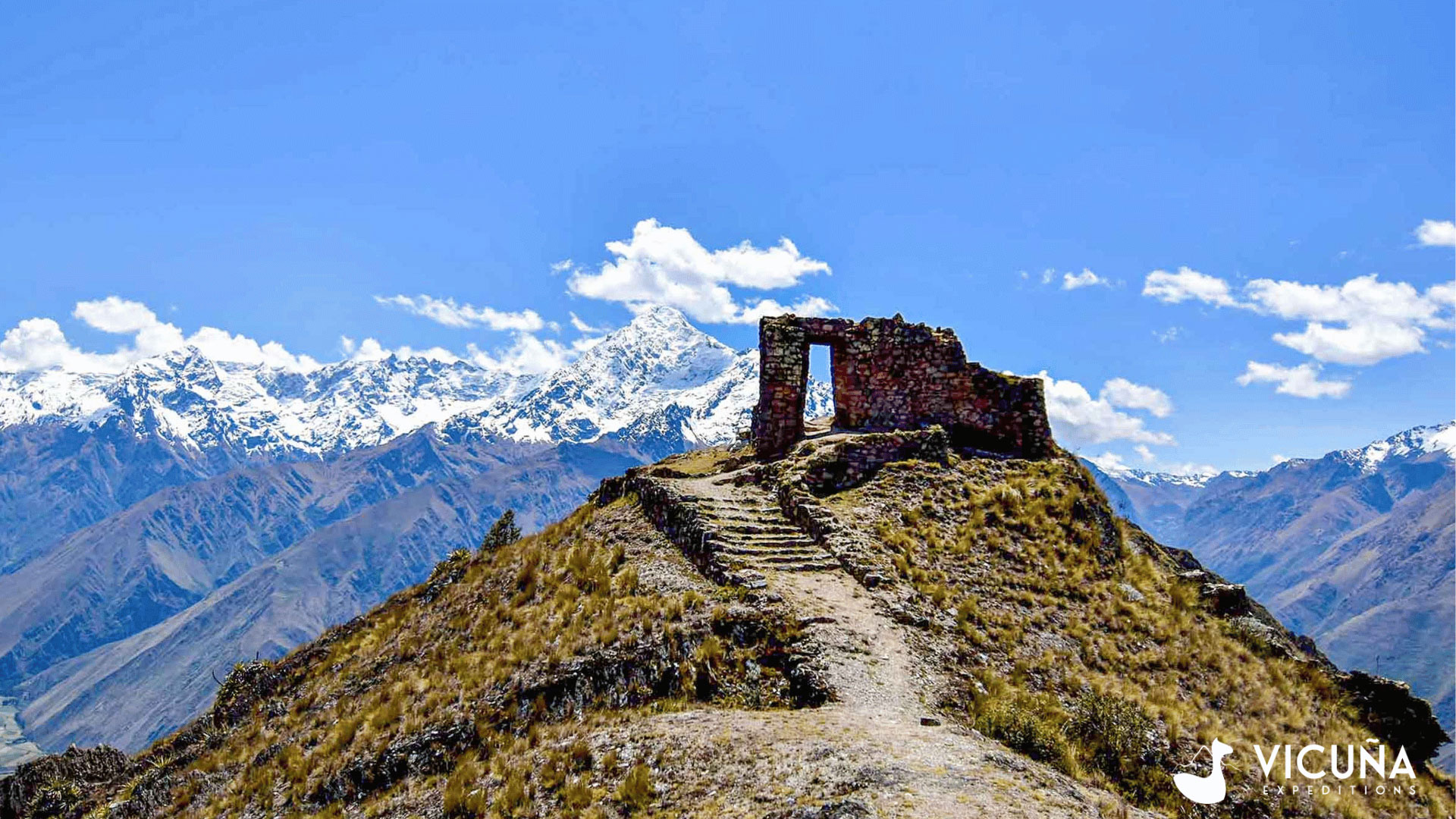
The famous Inti Punku “Sun Gate” in Ollantaytambo
Cachicata is a well-known Inca Quarry Trail in the Sacred Valley of the Incas. The Incas sourced red granite blocks from this area to build temples and palaces in the archaeological complex of Ollantaytambo and many nearby establishments.
Etymologically, “Cachicata” comes from two Quechua words:
In Spanish, it means salt slope because it is believed that during the Inca period, there were salt mines in this area. Also, these deposits had been used to preserve food as offerings in religious ceremonies during those times.
The Cachicata Quarry trek is located in the region of Cusco, 8 km from Ollantaytambo in the Sacred Valley, at 3,644 metres/11,955 feet.
The route to reach the Cachicata Quarry area has two sections. The first section is the bus ride that takes approximately 15 minutes from Ollantaytambo to Cachicata village, the starting point of the hike. The second part is the hike that takes approximately three hours uphill to discover and appreciate this tourist attraction.
During the Inca empire’s expansion and growth, the Cachicata quarry was a vital centre for rock material supply. In this quarry, the Inca builders produced, selected and transported enormous stones using their techniques (rolling and pushing).
Undoubtedly, moving these enormous lithic pieces from the place of fragmentation and edging to the main road for their subsequent transfer was an extremely difficult and risky task claiming the lives of many people due to work accidents.
Nowadays, during the hike, you can see enormous stones of different sizes and shapes that were left half-worked after the Spaniards arrived.
This quarry is the largest and has an enormous rocky cliff where traces of the Incas’ immense work remain. In this quarry, the most striking feature is an enormous piece of red granite with a circular shape and an indentation in the central part, also circular. This circular rock has the shape of a wheel and is completely polished with finely carved edges.
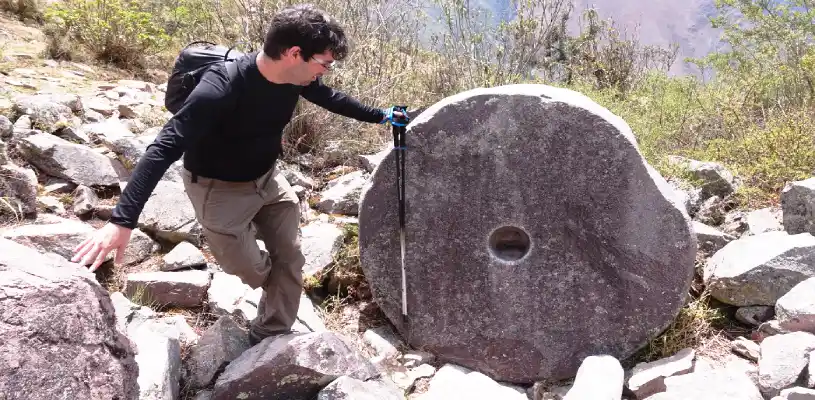
Circular wheel-shaped stone is believed to have been used to transport huge lithic pieces using a rolling and sliding technique.
This is the first quarry seen on the way up. It has a wall approximately 80 metres long and 4 metres high. It is a chaotic group of different-sized stones that seem to have been rolled down from the upper parts of the mountain. You can see worn pieces that were made in the process of shaping.
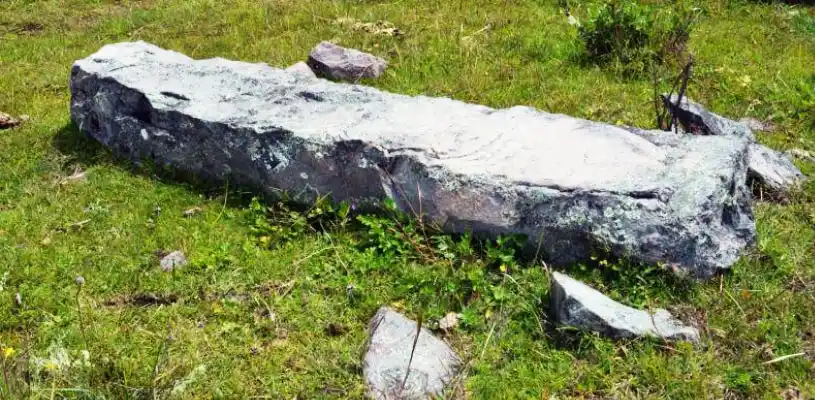
Piece of red granite of robust elongated form ready to be moved from Cachicata quarry to Ollantaytambo.
The Inti Punku or “Gate of the Sun” of Cachicata is located at the top of the mountain, at 3,886 m.a.s.l./12,749 ft. This structure was built in honour of the sun, which normally welcomes the winter solstice’s first rays. From this point, you can appreciate an impressive view of the Sacred Valley and the surrounding snow-capped peaks such as Wakay Willka, known as Nevado Verónica nowadays.
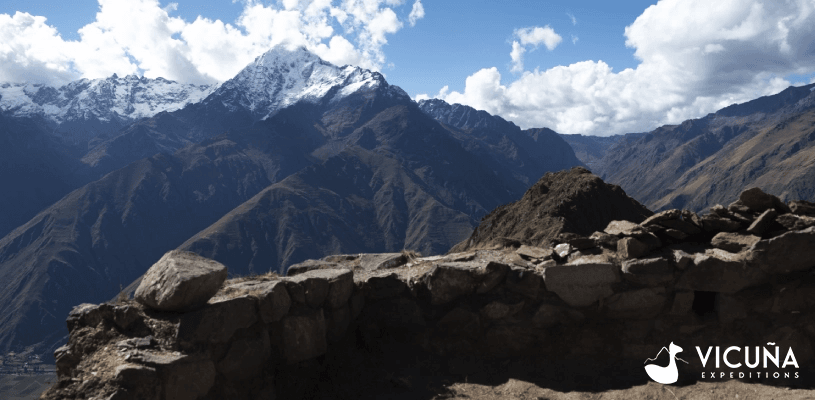
Viewpoint of Inti Punku in front of the snow-capped Veronica (Wakay Willca).
They are circular constructions of small size located on top of enormous granite stones. They are built with small rustic pieces joined by red mud mortar and straw. They have a roof and small access doors oriented towards the sunrise. It is believed that noble people were buried in these Chullpas during the Inca period. The deceased were generally placed in fetal position together with some of their most valuable belongings.
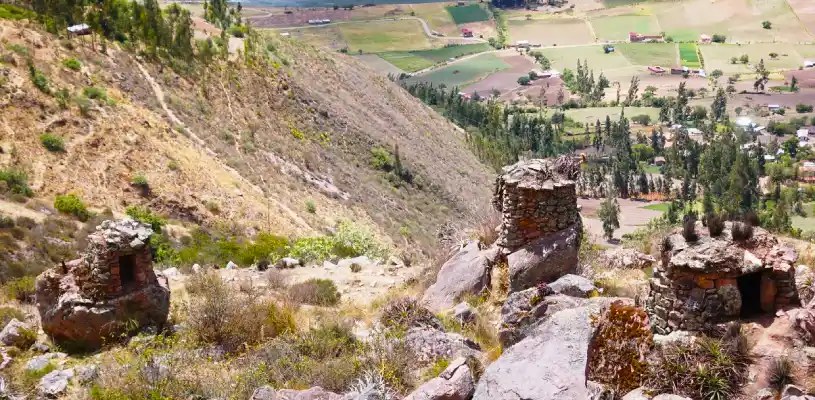
Three Chullpas of the Cachicata quarry overlooking the sacred valley
Hundreds of unfinished cubic shapes are deposited in the lower part of the quarry. With all these carved stones the Incas intended to build structures, walls and ceremonial places in the great llaqta of Ollantaytambo.
The truncated pyramid of Pacaritampu has a large extension with wide terraces still cultivated by locals. It can be seen from the top of the Cachiccata quarries and you will witness the pyramidal representation and the magnificent landscapes.
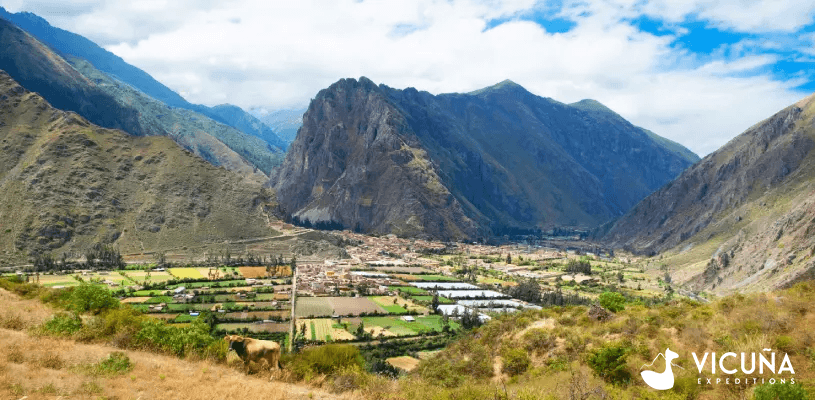
The optical effect of the Pacaritampu pyramid observed during the Cachicata Hike
The “tired stones” or “sleeping stones” are those abandoned stones that can be seen along the route from Cachicata quarries to Ollantaytambo and in some parts of the town.
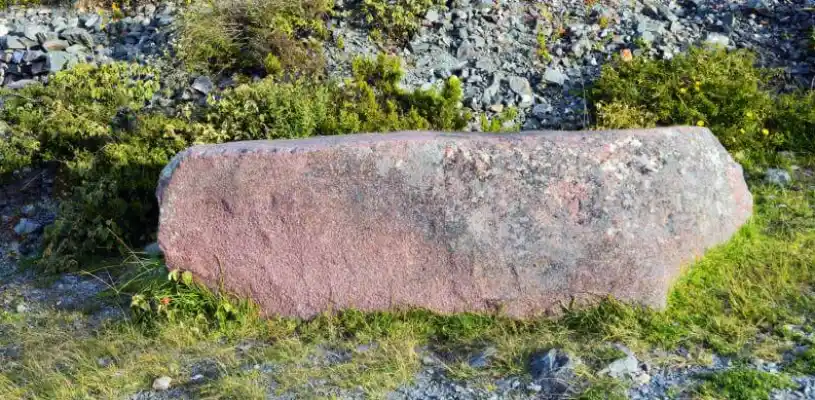
Tired stone at the side of the road to Ollantaytambo
The Inca quarry trail to Machu Picchu is another alternative path to Machu Picchu. During this hike, you can appreciate beautiful natural landscapes and it is highly recommended for those people who wish to have some time for themselves as Cachicata is not a very busy route.
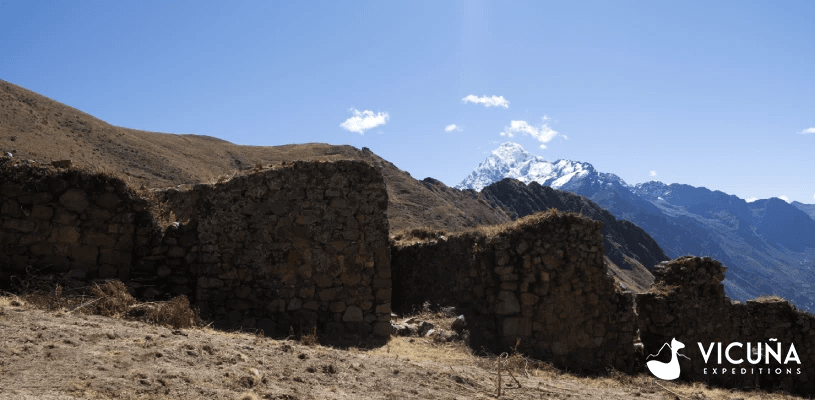
The archaeological site of Choquetakarpo with a view of the Sun Gate (Inti Punku).
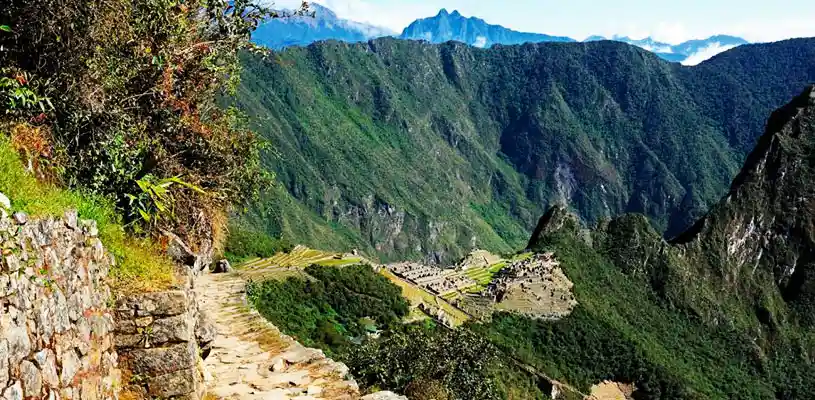
Day 4 of the Inca Quarry to Machu Picchu tour
It is also possible to trek to the Quarries of Cachicata Ollantaytambo in a full day, another option to visit this enchanting place. This adventure is ready for people who want to see new places and challenge their limits.
We will pick you up from your hotel and then drive you to the hike beginning point near Ollantaytambo (duration of 1 hour and 30 minutes).
Afterwards, it is about a three to four hour hike to the Intipunku viewpoint. During the walk, you can see the famous quarries of Cachicata, the tired stones, Chullpas, the pyramid of Pacaretambo (Pakaritampuc) and high mountain landscapes.
After enjoying the magnificent view, the descent begins, which is much easier and shorter. The descent takes about 2 hours. The transport will wait for us to return to the navel of the world “Cusco”. And this is how the Cachicata trek adventure ends.
The starting point of the Cachicata Trek, Ollantaytambo
This full-day Cachicata Trek map is easy to understand and highlights the most important towns, roads and archaeological sites during the tour.
Cachicata Trek Map
| Common name | Scientific name | Description |
| White corn | Paraqay sara | Also known as “choclo”, it is a typical Cusco food. For the Incas, it was a fundamental part of their diet. It was present in most of their rites and festivities. |
| Potatoes | Solanum tuberosum | The Incas were the first to eat potatoes. This was another important food for their diet, as the Incas knew how to make the most of its benefits, thus managing to produce “chuño”, which was a potato dehydrated by low temperatures. |
| Panti flower | Cosmos peucedanifolius | Panti flower is a native medicinal plant from the Andes. It cures coughs, flu, colds and bronchopneumonia. It is taken as an infusion, which is a simple preparation. |
| Mushrooms “K’allampa” | Suillus luteus | Also known as “Kallampa” because it is believed that where lightning strikes, mushrooms grow. The Inca created delicious dishes with this food. |
| Oca | Oxalis tuberosa | The oca is the second tuber after the potato to be cultivated in this area. Due to its exquisite taste, it is currently used in sauces and soups. |
| Rosemary | Salvia rosmarinus | Rosemary is a branching shrub useful for abdominal cramps. In popular culture, it is used to wash hair, as it helps to moisturise the scalp and is a natural conditioner. |
| Matico | Piper aduncum | Matico is a popular medicine in the Cusco region. It has healing properties, in the same way, its leaves in an infusion help with stomachaches and diarrhea. |
| Queuña | Polylepis Incana | The highest forest in the world. It grows up to a height of 15 metres along the Vilcanota Mountain Range. |
| Common name | Scientific name | Description |
| Mountain Vizcacha | Lagidium viscacia | During the Inca period and many years after, the vizcacha hair was used to make textiles for the nobility. |
| Hummingbirds | Trochilidae | Also known as Colibri or “Siwar Q’ente”, it is one of the most representative animals of the Cusco region. It has beautiful colours and is one of the fastest birds in the world. |
| Siskins | Carduelis carduelis | Siskins are attractive small birds that inhabit fields around Ollantaytambo. |
| Andean Geese | Chloephaga melanoptera | It is an Andean bird with white plumage and black spots on its wings and tail. This bird inspired a dance of the same name. This dance shows the courtship of the “Wallatas” (male and female) where they show their fidelity because they are monogamous birds, that is to say, they only have one partner throughout their lives. |
| Llamas | Lama glama | They are the best known animals of Cusco, and the Incas used their wool and meat. Llamas were used to transport goods and for religious ceremonies. |
| Alpacas | Vicugna pacos | Alpacas are fluffy, endearing animals valued for their luxurious fleece. They thrive in South America’s mountains in herds led by dominant males. Alpacas are cousins of llamas and vital to the Andean culture and textile traditions. |
| Andean Condor | Vultur gryphus | The condor (Kuntur in Quechua) was a sacred bird for the Inca empire. The Incas believed it was immortal and communicated the upper world (Hanan Pacha) with the earthly world (Kay Pacha). |
| Sheeps | Ovisorientalis aries |
In these areas, sheep farming is part of the transcendental culture, and the villagers often reap the benefits of their wool, leather, and meat as well. |
Many travellers when deciding the date of their trip have this doubt. The seasons in Cusco are well-defined and two:
However, it is best to be prepared as you never know if a sunny day can turn into a downpour in seconds.
During January, the average daytime temperature is 20° C/68°F while at night the average nighttime temperature is 8° C/46°F. In January it rains at least 20 days of the month.
During this month the average daytime temperature is 18° C/64°F and the average nighttime temperature is 7° C/45°F. The weather is quite cold, and it rains 20 days.
During this month the average daytime temperature is 20°C/68°F while the average nighttime temperature is 8°C/46°F.
During this month the average daytime temperature is 21°C while the average temperature is 6°C.
During this month the average daytime temperature is 21° C while the average nighttime temperature is 4° C.
During this month the average daytime temperature is 20° C and the average nighttime temperature is 2° C/36°F. In this month, one of Cusco’s most famous festivities occurs: “The Inti Raymi”.
During this month the average temperature during the day is 20°C/68°F while the average temperature during the night is 0°C/32°F.
During this month the average daytime temperature is 21°C/70°F and the average nighttime temperature is 3°C/37°F.
During this month the average daytime temperature is 21° C and the average nighttime temperature is 5° C.
During this month the average daytime temperature is 22°C/72°F and the average nighttime temperature is 7°C/45°F. In October the dry season ends, so it is the last month you can visit.
During this month the average daytime temperature is 22°C/72°F while the average nighttime temperature is 7°C/45°F.
During this month the average daytime temperature is 21°C/70°F while the average temperature is 8°C/46°F.
Without a doubt the most ideal time of the year to do this magnificent hike is between May and October, the best months being June and July. During these months the trails are dry and the weather will be lovely. The rainy season is between November and April, with the rainiest months being January and February. During this time of year, the trail will be wet and difficult to hike.
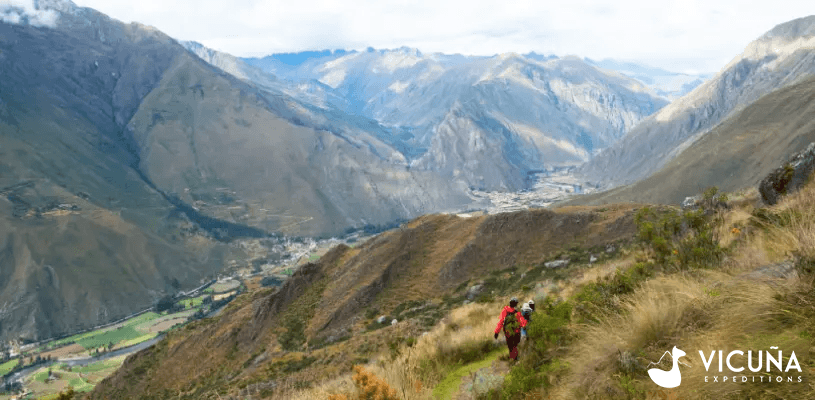
Hike to Inti Punku, Cachicata Quarry
Anyone trekking above 3,500 m.a.s.l / 11,482 ft. needs to be physically active regularly. Altitude sickness is a real risk, so it is recommended to acclimatise by spending a day or two in Cusco before the hike. Most people complete the Quarry Inca Trail without problems. Drink plenty of water as you hike and pace yourself.
If you suffer from altitude sickness or the famous “Soroche” during your hike to the Cachicata quarry, the recommended first thing to do are:
In order to achieve this hike without difficulty, we recommend you bring:
To visit this tourist destination you don’t need a tourist ticket. So don’t wait to face this new adventure.
The hike to the Inca quarry of Cachicata is part of the Inca trail circuit through Peru and part of the Qhapap Ñan circuit. It is suggested that you do this hike under the supervision of an authorized and highly trained agency that offers a professional guiding service so that you can be satisfied with the hike to the Cachicata quarry.
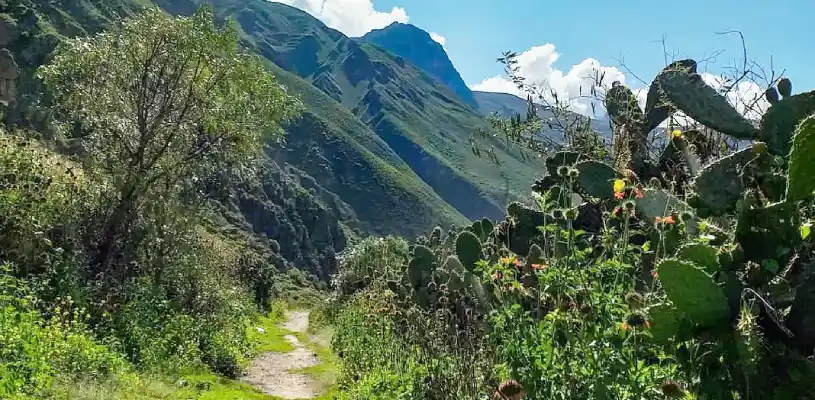
If you want to live an extraordinary experience and enjoy Andean landscapes without crowds, do not miss this extraordinary adventure to the Cachicata Quarry, and enter into the majestic natural landscapes, culture and history of Peru.