The closest and most beautiful Inca site in the Cusco area, this spectacular Inca site can be accessed in 1 or 2 days of hiking from Cusco or the Sacred Valley. Huchuy Qosqo can only be compared with Machu Picchu or Choquequirao; its magnificent location on top of a mountain offers a great view of the Sacred Valley and the Andes mountains.
The trek to Machu Picchu from Huchuy Qosqo is a popular option for travelers who want to avoid the crowded trails around Cusco. If you’re looking for an adventure-filled trip to Machu Picchu, the Huchuy Qosqo Trek is a great option.

Huchuy Qosqo, or Little Cusco, is an amazing Inca archaeological site located north of Cusco at 3,650m / 11,975 ft. The name comes from the Quechua language that means “Little Cusco.” This amazing ancient Inca citadel overlooks the Sacred Valley right above the town of Lamay in the Province of Calca.
The location right above the Sacred Valley allows Travelers to enjoy one of the most amazing views in the Cusco region; you can access this site on a hiking tour from Cusco or the Sacred Valley.
Huchuy Qosqo was occupied by a pre-Inca settlement, located in the Warqana sector as the Killke occupation and later Inca. The seventh Inca Yawar Waqaq decided to expand his territorial domains towards the Qaitomarca area in the Yucay and Calca valley. Later, Inca Wiracocha subdued the inhabitants of Qaitomarca, Xaquixaguana, now known as Huchuy Qosqo, and the rest of the villages.
According to Pedro de Cieza de León, in 1410-1438, Wiracocha decided to retire with all his followers to a rocky hill seven leagues from Cusco above the town of Calca and ordered the construction of a palace in Xaquixaguana for his old age, where he would spend his last days. He had to design the layout of the palace himself.
Colonial Period
After the arrival of the Spanish in Cusco, land distribution and encomiendas began, and haciendas were created. Huchuy Qosqo became part of the Pauqart’ika hacienda house in the early 17th century in 1604. It was owned by Francisco Merino and his wife Catalina Pereira, who acquired the right to burial in one of the chapels of the Santo Domingo convent.
Subsequently, it was owned by different owners until 1809, when it curiously appeared registered as the property of the La Merced Convent, which leased it to Francisco Rosal until 1814, being the last tenant of the hacienda. During the colonial times, Huchuy Qosqo was the quarry of the Incas, where there were cut stones and stones to be cut, and the stone walls were next to the houses of the estate.
The monument was looted, Inca constructions were demolished, and through encomiendas, the lithic elements were transferred for the construction of the Pauqart’ika hacienda house. A reservoir of 2000 m3 was also built, for which several enclosures had to be demolished and the lithic elements reused.
Huchuy Qosqo was a small Inca settlement located near the city of Cusco in Peru. The site was first excavated in the early 20th century and has since been restored. The site’s main features include a series of temples, plazas, and storage buildings.
The citadel structure, the terraces, the irrigation, location, and buildings assumed an important administrative and military center above the Sacred Valley.
Many large buildings called Kallanka (Great Halls) are resting places for high-class people. Also, several buildings called Qolcas store food like corn in the higher areas. The Inca built an irrigation canal of about 800m to provide water for the site.
It’s also possible to find impressive farming terraces adapted to the shape of the mountain.
Currently, Huchuy Qosqo is known as Little Cusco and is an adventure tourist attraction, a long and unforgettable hike. Huchuy Qosqo represents the buildings in the middle of a strategic place, on a very high hill that connects with the landscape and has a panoramic view of all Urubamba, Calca, and Lamay.
The Archaeological Zone of Huchuy Qosqo or Caquia Jaquijahuana was declared a National Heritage on August 19, 2003.
Huchuy Qosqo comes from the Quechua word “Juchuy” meaning “small” and “ccoscco” meaning Cusco, which is the designation of the archaeological capital of South America, called the city of the Incas, collectively known as “Little Cusco.” However, according to some chroniclers, the name of Huchuy Qosqo would be Xaquijaguana, among other names:
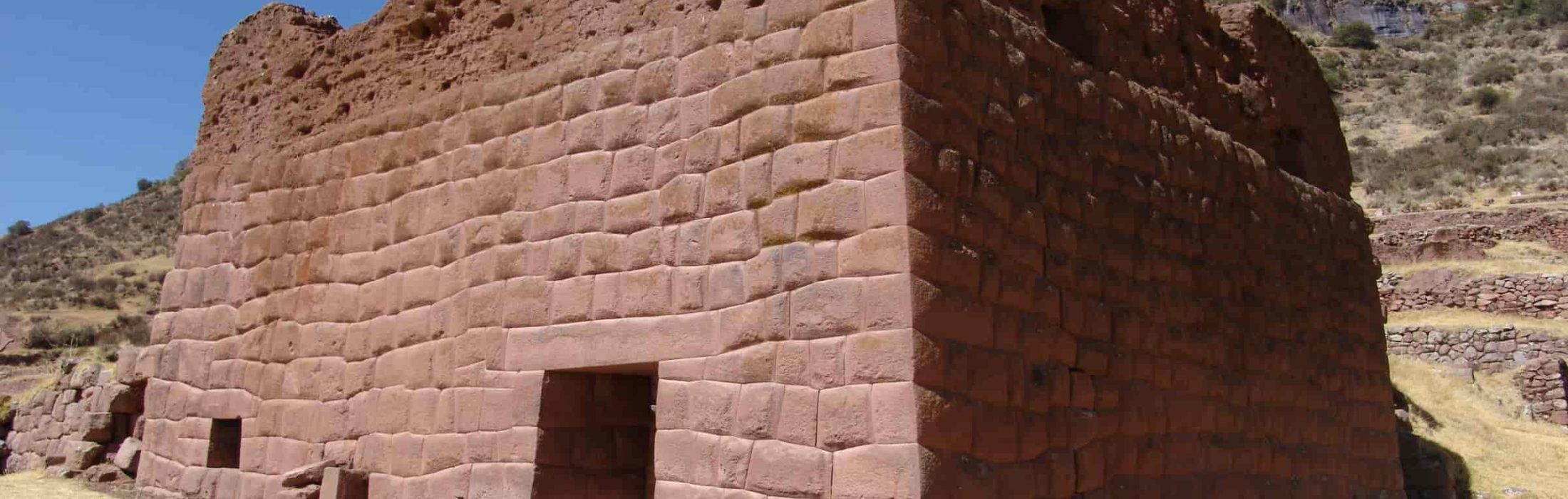
The archaeological zone of Huchuy Qosqo has a planning and distribution of ordered enclosures. The architectural construction patterns are typical of main centers, with particular characteristics. The structures are made of carved and cut stones. The interior and exterior of the enclosures are plastered with mud. The terraces play an important role as retaining walls and agricultural platforms.
It corresponds to the eastern end of the Huchuy Qosqo archaeological zone. The locals call it Haukaypata. The southern edge of the esplanade is protected by the retaining wall or terrace, while the northern profile of the esplanade is an open balcony. The esplanade is not a parallelogram, meaning it is not quadrilateral. In the esplanade, two rocks close to the southern terrace can be seen. The esplanade was the place where ceremonies and sacrifices were held.
It has a system of terraces that surround the northern and western flanks of Huchuy Qosqo. The terraces run in parallel lines from east to west to the main esplanade or plaza. The masonry is of a cellular style with an average height of 4.00 meters. Some terraces have stairways that connect from one terrace to another, with a central column dividing two opposite staircases, with channels throughout the site that run horizontally and vertically, where water drains for cultivation.
The constructions are distributed over the three levels or platforms that extend to the west of Haukaypata or the main esplanade. The upper platform houses the largest buildings with the best stonework and adobe constructions, symmetrically arranged. In the middle is the colonial reservoir. There is an enclosure that shows a finely carved stone wall, with a polygonal style on both faces, with a stone and adobe conglomerate filling in the middle. To the west of the reservoir, two similar enclosures can be seen in shape, size, and construction material of adobe, with the twin enclosures’ walls featuring niches.
There are rectangular kallankas of different sizes, some larger than others, scattered throughout the archaeological site. The largest kallanka is parallel to the esplanade, profiling the southern edge with a length of 54 meters and a width of 17 meters. These kallankas serve a social function of sheltering people in different social activities.
There is a large water reservoir from the colonial period, located in the middle of the enclosures, with a capacity of 2000 m3. Its walls are made of stone with lime-clay mortar. It is currently non-functional. Several enclosures had to be removed, and lithic elements reused to construct this reservoir.
It is the Inca road that comes from Cusco and enters the area through a double-jamb gateway, built with adobe on stone walls. The road features cobblestones, retaining walls, and containment on the sides.
It is a rectangular enclosure constructed of worked stone with mud mortar, located on the eastern side of the Huchuy Qosqo archaeological complex, on the edge of the cliffs, from where there is an excellent panoramic view of the Calca and Lamay valley.
Located north of the viewpoint in sector II, it consists of a narrow passage along the cliff of the large escarpment at the top of the paucartika hacienda, which is a small esplanade worked in rock. Much of this tunnel has collapsed, with only three meters of length remaining.
Located northwest of Pukamarca and southwest of Huchuy Qosqo, it recorded a large number of cut stones on the surface, ready for transport to the construction site, as well as stones in the process of being worked.
According to chroniclers, Inca Wiracocha chose Huchuy Qosqo as his abode for his old age, tired of governing, seeking peace and quiet in this place, and it was here where he spent his last days. However, other chroniclers mention that Wiracocha fled Cusco and went to Xaquixaguana, where he was confined by the Chancas, and there, after several years, he died, disinherited from the city of Cusco. Sarmiento de Gamboa says he was buried there and that Gonzalo Pizarro discovered the body and a large amount of gold, burned the body, the natives collected the ashes and hid them in a pot.
The area where Huchuy Qosqo is located has two seasons: the dry season and the rainy season. The rainy season is from November to April, with the highest incidence of rains from January to March. Morning and night fog are constant. The dry season, from May to October, has no rain and notable temperature drops. The temperature fluctuates between 11 and 16 °C.
The best time to visit Huchuy Qosqo is during the intermediate seasons, between April and May or September to November, when the weather is more pleasant. However, you can enjoy this place all year round. In the rainy season, the landscape is covered with vegetation, giving it a beautiful green tone.
If you prefer the dry season, keep in mind that nights can be very cold, and the environment quite dry, which can be problematic if you have dust allergies. Be sure to pack the essentials to enjoy this experience without mishaps.
If you plan to visit Huchuy Qosqo, consider the following recommendations:
Admission to Huchuy Qosqo is free, and entry hours are Monday to Sunday from 08:00 am to 05:30 pm.
Live the adventure of walking along the Inca trail, leaving footprints that connect the past, present, and future, finding immense pleasure in the Huchuy Qosqo kilometer. This is a long road to travel. The rugged topography won’t matter when it comes to this site. It will be worth hiking a few hours to see a magnificent strategic Inca construction that will surprise you at first sight. Every adventure begins with a yes.
Check out our tour: Huchuy Qosqo Trek to Machu Picchu 3D/2N